Right now, Denver is booming. From all over the United States, people are flocking there. On a recent visit I heard different estimates of how many were arriving – several hundred people a week or even per day, depending on which Uber driver I was speaking to. People come for the good weather, the outdoors life and more recently for the recreational weed, which has legal since 2014.
The city hasn’t always been such a magnet of course. Like any place else, Denver has had its historical ups and downs. The oil price crash of the early 1980s and the recent slump from early 2015 bookend the transformation in the city’s fortunes over the last three decades and reflect how the local economy has diversified from its reliance on the energy sector. Going back to the 1980s and early 1990s, Denver’s downtown area was in a state of what appeared to be near terminal decline.
‘Imagine a Great City’
The influential former mayor, Frederico Peña, was pivotal in turning things around. He was elected on the back of a campaign slogan which boldly stated, ‘Imagine a Great City’, although it wasn’t until his second term that major capital projects such as the new airport and convention centre came to fruition.
But perhaps Peña’s most curious and brilliant initiative was the Denver Public Art Program, created by an executive order in 1988 and becoming a city law (or ‘ordinance’) three years later. The ordinance requires the city to set aside one percent of any capital improvement project with a budget of more than $1 million to finance public art. The stated purpose of the program was to ‘expand the opportunities for Denver residents to experience art in public places, thereby creating more visually pleasing and human environments.’ At the time, many critics scathed: ‘People are getting shot, why are you paying for art?’
Mayor Peña, however, had an instinct his detractors lacked. The introduction of the program suggests he was an early adopter of the notion that public art, especially when a part of broader regeneration policies, can help combat elements of social exclusion. On some level, he must have had faith that art could be transformative. It was about making downtown in particular a place that people would be drawn to visit again. One former head of the program, Michael Chavez, put the significance of the program like this: ‘It’s extremely important as our city is growing that art is included in design and planning of certain buildings. If you think about any great city in the world — London, Paris, New York — it’s not the sewers or the sidewalks people remember. It’s what the cities offer in art culture.’
Citizen participation
In fact, Denver’s program has more in common with say Newcastle than London, in terms of a strategy to systematically integrate art into place regeneration. The basic theory of how this works is twofold: firstly, public art can contribute to ‘place management and beautification, aimed at improving environmental quality and place attachment’; secondly, the actual production of artwork on this scale creates economic opportunities through jobs, materials and supply chains, just as with any piece of infrastructure.¹ This is a point not always so well grasped by critics who think that funding art is just a waste of money.
But where the city has really excelled has been in successfully involving its citizens and communities on the selection panels that commission winning artists from the numerous proposals that are received for any particular project. Being involved in this selection process gives residents a uniquely positive opportunity to shape their own neighbourhoods, in what John Grant, another former head of the program, described as the only ‘non-punitive interaction’ (i.e. not paying a parking fine) that many people have with the city.
Follow the bear
To date over 300 art pieces have been financed at a cost of nearly $32 million. The program has sparked plenty of debate and controversy along the way – both about high profile, individual artworks and the fundamental principle of tax dollars being spent on art. However, causing people to debate and engage with how their urban environment continually evolves is surely in itself a substantial benefit. The question of who pays of course is likely to persist.
In thinking about people’s diverse and often intense reactions to public art I’m reminded of Steve Jobs’ famous quote eschewing market research: ‘Customers don’t know what they want until we’ve shown them.’ No one ever said (except the artist) that what Denver’s convention centre really needs is a giant blue bear looking through the window. Yet the bear has become an iconic feature of a facility that’s been vital to expanding the local economy. The best street art most often seems to surprise us with its playfulness while at the same time making perfect sense in its specific context.
Similar commitments to public art now exist in other cities across the US and around the world, these days often with bigger budgets. But with a program still going strong after 25 years, Denver offers a fascinating case study of how the integration of public art in planning can potentially lay the foundations for urban renaissance.
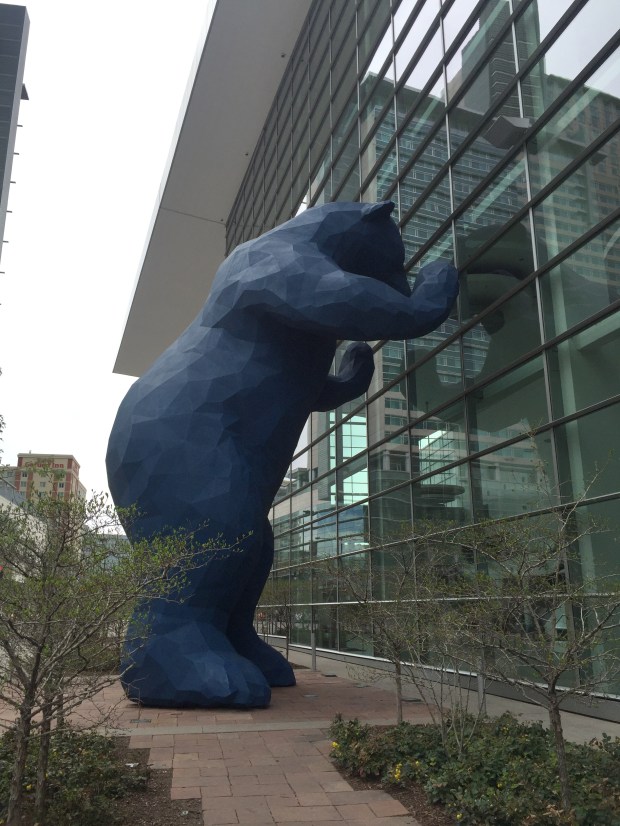
‘I see what you mean’ by Lawrence Argent. Denver Convention Center
References and further links
1.Tornaghi, Chiara (2007). ‘Questioning the social aims of public art in urban regeneration initiatives. The case of Newcastle upon Tyne and Gateshead (UK),’ p.4. Accessed at:
http://www.ncl.ac.uk/guru/assets/documents/EWP42.pdf on 4 June 2016.
Browse Denver’s extensive public art collection at:
http://artsandvenuesdenver.com/public-art/denver-public-art-collection/
If you take a trip to Denver, check out http://www.denverfreewalkingtours.com for a really fun way to see the city and some great public artworks.
 fuzzyhorizons